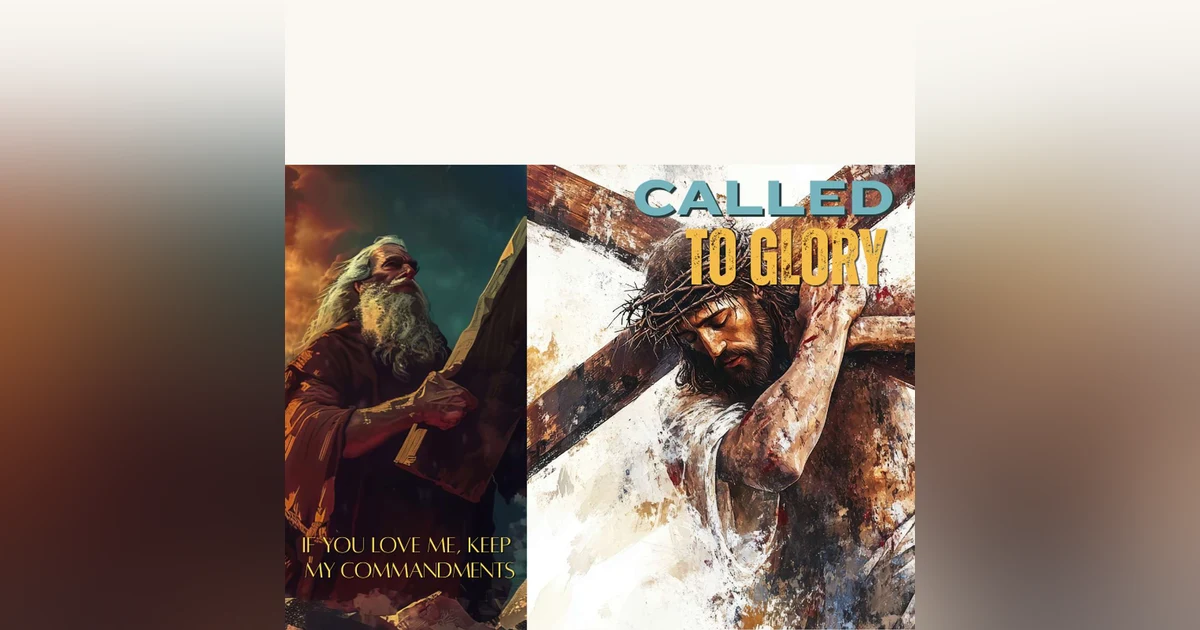
If You Love Me Keep My Commandments


 RSS Feed
 Welcome to “Called to Glory,” the cutting-edge weekly podcast dedicated to helping you know Christ, the power of His resurrection and the fellowship of His sufferings.
In this series, we’re going to answer one of the most important and hotly debated questions in all of Christianity. And, for that matter, Messianic Judaism in all of its various forms.
What law are we under as blood-bought disciples of Christ?
At first blush, that may seem like a no-brainer as I think most believers would readily agree it’s the Law of God! Which of course is absolutely correct. After all, one of the great promises of the New Covenant is that God will place His law in our minds and write it on our hearts. And if that’s as far as you care to take it, everyone can generally get along just fine.
However, the minute you start asking exactly what that means and looks like in real life – not to mention when we all stand before Christ as Judge - it’s a very different story altogether! If you’ve been a believer for any length of time, you know exactly what I’m talking about. There are almost as many opinions about this as there are versions of the Bible! It’s literally a theological and spiritual minefield. The good news, however, is it doesn’t have to be this way.
The truth is God has committed all judgment to the Son and the Bible declares that He will judge everyone – Christian, Jew or otherwise – not only according to what we do, but also according to our motives, thoughts and even our words. Paul - the apostle of grace – left no doubt about this when he wrote that God “will render to each one according to his deeds: eternal life to those who by patient continuance in doing good seek for glory, honor, and immortality; but to those who are self-seeking and do not obey the truth, but obey unrighteousness — indignation and wrath, tribulation and anguish, on every soul of man who does evil, of the Jew first and also of the Greek; but glory, honor, and peace to everyone who works what is good, to the Jew first and also to the Greek.”
Yes, God most certainly is love but the Bible also declares that the foundation of His throne is righteousness and justice. He is just as concerned with holiness, justice and righteous behavior as He is with mercy, grace and forgiveness.
So in light of the apostle John’s warning that, “He who says, “I know Him,” and does not keep His commandments, is a liar, and the truth is not in him,” I think we would all do well to get this right. Fortunately, God has not hidden the ball from us and neither has He shrouded this in such mystery that no one can possibly understand it. Just as no prophecy of Scripture is of any private interpretation, there is only one correct answer to this question and praise the LORD, He has not left us to our own devices to figure it out.
Join me as we take a quick look at some of the main schools of thought about this in Christianity and Messianic Judaism before answering this most important question:
What commandments was Christ referring to when He said, “If you love Me, keep My commandments”?
Soundtrack music:
"Awakening" by LNDÖ
"Believer" by IamDaylight
"Revolution" by Shimmer
"Worthy of Greatness" by Cody Martin
Scripture taken from the New King James Version®. Copyright © 1982 by Thomas Nelson. Used by permission. All rights reserved.
Either Christ is the prophet greater than Moses, or he's not. It's that simple. If he isn't, just convert to Judaism, take on the yoke of the Torah, and go all in with Moses. If, on the other hand, he is the prophet greater than Moses, then do what Paul and the other Jewish apostles did. Put Moses in his proper God-given place of honor alongside the prophet Elijah. Take up your cross and follow Christ with everything that's within you, which in turn brings us right back to the law of Moses. You see, the early church didn't just go to sleep one night under the Mosaic Covenant and wake up the next morning in the new. That's not how God works. Instead, there was a gradual and divinely ordered transition from one to the other, just like the gradual transition from night to day, if we see it sunrise. In other words, as the new covenant was coming into definition, the Mosaic Covenant was in the process of fading away, exactly as the letter of the Bruce said. Welcome to Call to Glory, the cutting edge weekly podcast dedicated to helping you know Christ, the power of his resurrection, and the fellowship of his sufferings. If this is your first time tuning in, please be sure to like, share, comment, and subscribe. In this episode, we're going to answer one of the most important and hotly debated questions in all of Christianity, and for that matter, Messianic Judaism in all of its various forms. What law are we under as what bought disciples of Christ? Some say it's only the words of Christ in red, while others to one degree or another take a more expansive view. Still others teach that he was referring to the law of Moses, while yet others are somewhere in the middle. It's literally a spiritual and theological minefield. For example, many teachers in the evangelical, fundamentalist, and reformed camps genuinely seek to honor and glorify God, but do so through the lens of Hellenistic Gentile Christianity. They rightly emphasize the need for obedience and holiness, but vary considerably as to exactly what that means and looks like. One thing they generally do have in common, however, is a rejection of pretty much anything that looks or sounds Jewish, including the Hebraic foundation of the Bible itself. The scriptures are instead viewed through a predominantly Gentile lens, while the writings of early church fathers such as Augustine, Origen, and Justin Martyr, and even Protestant reformers such as Martin Luther and John Calvin often have almost the same level of authority as the Bible itself. Never mind the fact that they all, in one way or another, mixed Greek philosophy and thought with biblical truth, or the fact that this unholy mixture makes a mockery of the Reformation rallying Christ's sola scriptura. That's a huge mistake, and it inevitably leads to highly spiritualized and distorted views of matters such as justification, salvation, righteousness, sanctification, holiness, Israel, the new covenant, and the promised divided kingdom. Not to mention what Christ meant when he said, If you love me, keep my commandments. Now in this camp, Christians are free from the law of Moses, but are still governed by God's moral laws, such as the commandments concerning murder, adultery, stealing, coveting, marriage, and complete devotion to the Lord. Exactly which laws those are, however, varies depending upon who you ask. This certainly is a step in the right direction, but it too misses the mark. It's nowhere near specific enough for us to know with any reasonable degree of certainty what Christ meant when he said, If you love me, keep my commandments. We still have to account for all of the other instructions, exhortations, and commandments in both the Old and New Testaments, and this unfortunately just doesn't get us there. So now let's look at the other end of the spectrum, where we find the various expressions of messianic Judaism and its controversial offshoot, the Hebrew roots movement. Generally speaking, these groups place great emphasis on the Hebraic origin and Jewish character of the New Testament, the Apostles, early church, and of course Christ Himself, and rightly so. However, what started as a biblically correct response to Christian anti-Semitism, replacement theology, and the overwhelmingly Hellenistic orientation of modern Christianity has evolved into a highly organized religious movement that increasingly exalts Jewish culture, tradition, and identity over biblical truth. Let me explain. Viewed through this lens, everything in the Bible, including the New Testament, points back to the Torah and the law of Moses. Now some believe the entire Torah, as interpreted through Christ, is to be our guide, while others teach that we're only governed by what they call the moral laws of the Torah. Never mind the fact that the Bible makes no special distinctions in the law, or the fact that Christ is the prophet greater than Moses, and the Torah itself says it is him we are to listen to. Or the fact that Paul said Christ, not Moses, is the end or goal of the law for righteousness to everyone who believes. Not to mention all of the New Testament passages that clearly teach that those who are in Christ are no longer under the law of Moses. Now, of course, there are many variations of this, and the further you go down this road, the murkier things get. For example, many of these groups teach that keeping Torah is only required for Jewish believers, while Gentile believers are solely governed by God's moral laws. Still others twist the Hebrew text of Jeremiah 31 31 to claim that God promised a renewed Mosaic covenant rather than what the text actually says and means. A new covenant distinct and different from the one he made with Israel at Mount Sinai. Now this linguistic and theological sleight of hand, of course, is necessary to validate their view that everything points back to Moses and the Torah, and there's just no end to it. If you're not careful, you can get into the weeds spiritually and theologically faster than you can say John 316. When everything is said and done, however, in their minds it is Moses, not Christ, who in all things has the preeminence. The New Testament is therefore, to one degree or another, seen as nothing more than inspired commentary on the Torah. In other words, when Christ said, If you love me, keep my commandments, he meant the law of Moses. Perhaps the best example of this is the popular messianic teaching that Christ meant the law of Moses when he referred to these commandments in Matthew five, verses seventeen through twenty. And I freely admit that a superficial reading of this passage certainly does seem to support that view. And of course, this same reasoning is also applied to all of the other biblical passages that equate loving Christ with keeping his commandments. However, hardly anyone seems willing to consider, much less admit, the possibility that maybe, just maybe Christ was referring to what he said in the Sermon on the Mount, which, truth be told, also happens to be full of commandments. You know, things such as love your enemies, bless those who curse you, do good to those who hate you, and pray for those who spitefully use you and persecute you. Nor does anyone even seem to consider the fact that many of Christ's commandments in the Sermon on the Mount expressly supersede what is written in the law of Moses. Now apparently, none of that matters, as in their hearts and minds, Moses will always reign supreme. Another example of this is the popular messianic claim that Paul, or Roshul, as they love to call him, continued to identify as the Torah observant Pharisee after his encounter with Christ on the road to Damascus. In support of this, these camps love to point to passages such as Acts 21, verses 15 through 26, where Paul took a Nazarite vow to show the other Jewish believers that he himself kept the law of Moses in Acts 23, verse 6, where he referred to himself in the present tense as a Pharisee and the son of a Pharisee. Often they admit that a superficial reading of these passages once again certainly does seem to support this theory. However, it is nowhere near as simple and clear cut as these teachers would have us believe. On the contrary, a very different picture emerges when you read these passages together with the rest of the New Testament, and all the more so when you consider that everything Luke recorded in the book of Acts took place during the forty year transition from Moses to Christ. You see, the early church didn't just go to sleep one night under the Mosaic Covenant and wake up the next morning in the new. That's not how God works. Instead, there was a gradual and divinely ordered transition from one to the other, just like the gradual transition from night to day we see as sunrise. In other words, as the new covenant was coming into definition, the Mosaic Covenant was in the process of fading away, exactly as the writer of Hebrews said. This transition was complete when the temple was destroyed in seventy AD, which means that as long as the temple was still standing, the law of Moses remained in effect alongside the growing body of instructions, exhortations, judgments, and commandments being given by the apostles. This one detail alone puts everything Luke recorded in the book of Acts in his proper biblical perspective, so take heed. While this heavy emphasis on Torah and the law of Moses does indeed have the outward appearance of truth and respect for God's law, it actually does much more to confuse things than clarify what Christ meant when he said, If you love me, keep my commandments. We still have to account for all the instructions, exhortations, and commandments in the New Testament, and the fact is, an honest reading of the Bible leaves no doubt that what Christ and the apostles said and wrote is much more than just inspired commentary on the Torah. So here is where the path really starts to get narrow. Either Christ is the prophet greater than Moses, or he's not. It's that simple. If he isn't, just convert to Judaism, take on the yoke of the Torah, and go all in with Moses. If, on the other hand, he is the prophet greater than Moses, then do what Paul and the other Jewish apostles did. Put Moses in his proper God given place of honor alongside the prophet Elijah. Take up your cross and follow Christ with everything that's within you, which in turn brings us right back to the law of Moses. And the first question we're going to address is whether, as so many claim, it has been abolished. And what shall we say about this? There are so many passages in both the Old and New Testament that destroy this nonsense. It should even be up for debate, and I'm not going to waste your time or mine doing so. The answer is a clear and resounding no. Christ made it absolutely clear that he came not to destroy the law but to fulfill it. And furthermore, that not one jot or tittle of the law will disappear until all is fulfilled. Now I think much of the confusion surrounding this is due to the fact that many theologians and Bible teachers carelessly treat the law of Moses and the Mosaic or Old Covenant as one and the same. They're not. So let's clue this up once and for all. Simply stated, the Mosaic or Old Covenant was the agreement God made with the children of Israel at Mount Sinai. Turn with me to Exodus chapter nineteen. In the third month after the children of Israel had gone out of the land of Egypt on the same day, they came to the wilderness of Sinai. For they had departed from Refidim, had come to the wilderness of Sinai, and camped in the wilderness. So Israel camped there before the mountain. And Moses went up to God, and the Lord called to him from the mountain, saying, Thus you shall say to the house of Jacob, and tell the children of Israel, You have seen what I did to the Egyptians, and how I bore you on eagle's wings and brought you to myself. Now therefore, if you will indeed obey my voice and keep my covenant, then you shall be a special treasure to me above all people, for all the earth is mine. And you shall be to me a kingdom of priests and a holy nation. These are the words which you shall speak to the children of Israel. Again, this is the original covenant or agreement that God made with Israel at Mount Sinai. It is this, not the law of Moses that has been superseded by the new covenant in the blood of Jesus. Let me repeat that. The Mosaic or Old Covenant, if you will, is the original agreement God made with Israel and the Jewish people at Mount Sinai. The terms of the covenant are spelled out in much greater detail in other passages, such as Deuteronomy chapter 11, but the essence of the agreement was this. If the nation of Israel obeyed God's voice and kept his commandments, what we know as the law of Moses, then God would not only give them the land he had promised to Abraham, he would also bless, protect, and establish them as his special treasure above all people, a kingdom of priests and a holy nation. Once again it is this agreement, not the law of Moses that has been superseded by the new covenant. And just so we're all clear, I am talking about the new covenant Christ referred to when he told his disciples, This cup is the new covenant in my blood, which is shed for you. Turn with me to Jeremiah chapter thirty one. Behold, the days are coming, says the Lord, when I will make a new covenant with the house of Israel and with the house of Judah. Not according to the covenant that I made with their fathers in the day that I took them by the hand to lead them out of the land of Egypt, my covenant which they broke, though I was a husband to them, says the Lord. But this is the covenant that I will make with the house of Israel after those days, says the Lord. I will put my law in their minds and write it on their hearts, and I will be their God, and they shall be my people. No more shall every man teach his neighbor, and every man his brother, saying, Know the Lord, for they all shall know me, from the least of them to the greatest of them, says the Lord. For I will forgive their iniquity, and their sin I will remember no more. This is the new covenant in the blood of Christ. The law of Moses, on the other hand, is the body of commandments, statutes, judgments, and ordinances that Israel as a nation agreed to keep as its part of the Mosaic covenant. Not just the Ten Commandments, but all of the laws and instructions God gave to Israel concerning the priesthood, sacrificial system, dietary laws, agriculture, the feasts, temple worship, warfare, conduct of kings, sexuality, marriage and divorce, widows, orphans, and the poor, false prophets, leprosy, slaves and bondservants, and adjudication in civil disputes and criminal matters. It stands on its own independently of this or any other covenant, so let's put this to rest once and for all. The law of Moses has not been abolished or anything of the sort. That's it. End of story. However, this does not ipso facto mean that God meant the Torah when he said he would put his law in our minds and write it on our hearts, or that Christ meant the law of Moses when he said, If you love me, keep my commandments. He didn't, and here's why. If this is your first time tuning in, please be sure to like, share, comment, subscribe, and ring the bell so you can be notified whenever we post new episodes. If you like what you've heard today, please also leave a review wherever you're listening to this podcast. Tell us what you loved about this episode, how they have helped or encouraged you, or you can simply leave a comment about any other topics you'd love to hear us cover in the future. Finally, remember to always keep your lamps trimmed, lit and full of oil. Shalom and see you next time.